Dyslexia Symposium, University of Limerick

Quite a busy few days. Training parents and caters in Langham, Rutland. Then flying out to Cork, Ireland to attend a Dyslexia Symposium which was a good time with a wide range of speakers – ranging from access to work, to researchers to educationalists, university professors.

I never knew how big Cork is! I had to drive from Cork where my plane landed to attend the symposium in Limerick which took 1hr 45 mins. Actually over 2 hrs due to traffic through Cork. My Satnav took me that way which was long and slow. I learnt that the journey to Limerick took me through a couple of small towns typically one long street with few restaurants and many pubs!

The plane I am currently on is an ATR prop and is quite ecologically minded. Not uncomfortable with more leg room than my recent easyJet flight. Though the landing in Cork was a bit seat arm gripping! We came in fast and furious – I think the pilot was in a hurry to get somewhere!

It was great to attend the symposium and to make new friends in the University of Limerick. It is a huge campus with many, many students in comparison to Bath Spa University in size and number. I also learnt that with over 400 students requiring individual ICT support the task of provision was daunting in its logistics for examinations. Workable solutions such as scanning pens were needed. I also will take back to BATA the need to have one event in Ireland as the assistive technology needs to be driven as much there as here in the UK maybe some sort of exhibition event.

It was great to meet Nicola James (Lexxic) and Stephen Howell (Microsoft Ireland) . As both are involved in Ireland forming some sort of dialogue on how best to help showcase AT via the University of Limerick maybe an action point. It will need something big of the stature of Microsoft to make an impact at the decision making level of the University level to make a difference.

I was intrigued to know how I got invited to this event. Apparently, I was googled!!

Disability,ICT and Accessibility – an Assistive Technologist’s Perspective

Disability, ICT and Accessibility – an Assistive Technologist Perspective 

In reading Graham Pullin’s Manifesto it resonated with me as my early career options was to be a designer. But alas , that is not what I am now. I am  – for want of a better word- an Assistive Technologist. I find my role is to problem-solve from the disabled person and their circle of influencers with the disabled person in the middle.” 

“It’s good but it’s not Carling” 

This is the mantra of a recent Carlsberg advert but it is also a triusm for Assitive Technology where it just doesn’t quite meet the need.  Some speech recognition software  not designed for the blind especially does not read out websites. Siri does not read out websites or emails. Speaking Email does and on both iOS and Android. It doesn’t take a great deal of re-programming to make small adjustments to accommodate new disabled needs . When it comes to function it needs to do he complete job. Not half or three-quarters of the job! 

Design – form follows function – and is asethetically beautiful. 

In the education sector dyslexic pupil I have found do not want to stand out. They want to be like everyone else. That is why the iPad was so good. If everyone uses it  it becomes the norm. It’s not “special”. Remember VOCA’s ? Speech output devices. Generally speaking we need them but what if they were designed to be more discrete, more cool, even more lighter and portable.   

When I first started using eye gaze systems they were bulky and hard to configure. They were expensive, Only able to used in certain lighting conditions. This emergent phase led on to the bolt on solutions to existing kit that exist today, We can add them to our usual tools.  

New tools bring new uses 

Something totally new like the smart speakers and internet of things can open up the world to the blind and sensory impaired. They provide contact, intellectual interest , and control to their surroundings. Just by using your voice. For the dyslexic it can provide dictonary definitions. Short memory notes. Reminders and to do lists.  But there are more uses they could be put to we haven’t yet considered. The ability to write – author a book, write to an audience, make a podcast, develop a library of resources to share. What a powerful tool we have to employ/ 

And what about the users! 

Really important. The user /pupl/disabled person should be at the centre of design, implementation and research development. Or how else can we enable and empower the things that need to be enabled and empowered? We need to listen, empathise and modify our solutions to their not always PC wishes!!  Personal preference as well as personalised semantics should go hand in hand.  If someoene is familiar with a particular technology and someone wants to update – should they have to? ?  

On tour!

At the time of writing I am sitting in a conservatory of a hotel I stopped for a latte at on my way to do some training for a PMLD pupil and his parents, carers and support professionals. After that I high tail myself to Birmingham Airport to catch a flight to Limerick where I am at the

1st International Disability Emancipatory Research on Personalisation Semantics for dyslexic users.
Department of Computer Science and Information Systems, University of Limerick, Ireland.

I feel somewhat out of my comfort zone there as general I demonstrate how the technology works to support pupils with dyslexia but I will give it a go and show how simple interfaces win the day for dyslexic users. Giving too many options would confuse the cognitively challenged pupil. Not having the options would frustrate the high flier dyslexic so the message is “horses for courses.” Maybe in summing up I could point to avenues which research should go. Expert systems that tailor the package to the pupil’s ability and functioning almost seemlessly if that was possible. I applaud the way mainstream software producers have put in accessibility at the outset which I believe helps everyone not just the severe dyslexic. So let’s see how it goes! I will write a piece on it as well here.

NTE Hub is now in Find My Flow

Exciting News – NTEhub is now in FindMyFlow

We are really excited to announce NTEhub has now been added to FindMyFlow. This exciting product  is the latest addition to the growing resources available within FindMyFlow, the unique eLearning resource that combines study skills and assistive technology.

We are always working to add great new features to FindMyFlow and the introduction of NTEhub is another.NTE Hub is a full-featured note taking suite backed by a talented human note taker service. Choose to take your own notes within the platform or send your audio files to a note taker to accelerate your note taking workflow. You’ll also have access to your notes across all your devices on our platform.
NTEhub and FindMyFlow would like to invite you to one of our joint webinarsto get an overview of NTEhub and see how it fits within the resources in FindMyFlow.
 
Please click the date below to join.

RightHear

RightHear is a free app for the visually impaired to navigate around there surroundings. It is often difficult for a visually impaired person to locate where they are in relation to their surroundings. This clever little app tells you what is nearby and what is further away. Similar to Microsoft Soundscape I think this app is better as it gives clearer locations. I have a blind client who needs this so I will test run this app with him and get him to tell me how useful it might be

The missing cryptoqueen

BBC sounds have an enthralling 5 episode podcast about a scam know as OneCoin – a digital cryptobanking currency. I must confess as soon as I heard of Bitcoin my suspicion of how this could be manipulated were raised. But true cryptobanking relies on the system NOT to be manipulated through a convention know as a “block-chain”. Once this is in place you literally cannot tamper with the rates, Essentially this is a form of Networking Marketing. which in turn would be pyramid selling, based on getting more and more to sell a bitcoin so that you in turn get a cut. No doubt people do get rich – but only at the top of the chain. Ayway I found the BBC sounds podcast very entertaining and informative. Remember any get rich quick scheme must be suspect in my opinion.

https://www.bbc.co.uk/programmes/p07nkd84/episodes/downloads

Teacher Tapp

This is an app that I came across from the Teacher’s Development Trust. The app itself asks teacher’s 3 questions each day. The results are shared in the form of an article the next day. You can download the app for free and if you are a teacher you can join in.

Who can input questions? I found this on the website:

Who Can Ask Questions in the Teacher Tapp Survey?

We have some ground rules, but most businesses, organisations, researchers or policymakers will be eligible to submit a question. Gain fast insight into the products and services that teachers want and need, boost your advocacy position or scope a new research project. The Teacher Tapp app gives valuable insights to your questions within hours. Find out more about how to submit a question here.

Teacher Tapp is available in app stores in the UK (and a small group of northern European countries).

And this I found when I searched how to submit a question:-

https://teachertapp.co.uk/targeted-opportunities-for-teachers/

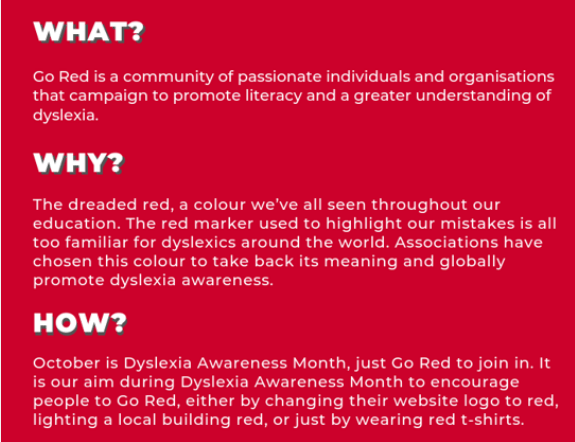
Let’s Go Red #letsgored

So why have we gone red during Dyslexia Awareness month. Here is three reasons why AccessAbility Solutions are doing this

Microsoft Word – Search feature

Searching for images from within Word

There is also a new feature called search. The above information was sought by using search window at the Top in the middle of the blue title bar. And by using smart look up was able to use and find the photo that I wanted. This feature will allow you to look at files and information and directly add them to your text within Microsoft Word and not having to leave it I’ll go in search elsewhere I also like the idea that for research purposes it includes some text along with this information.

This is a new feature which is in beta stage and obviously will be built more into the package but you can actually add it to your Microsoft 2019 package and start using it to see what it can do to aid students work and research methods. All this and no additional cost other than having the use of this package or paying a subscription for it. Simple ideas like this can really enhance learning. And I’m also using it with dictate to create this article which makes it even more interesting as a fully integrated method of working. Well done Microsoft for this feature which will help a lot of dyslexic students!

Microsoft Word – Dictate

(Written with a combination of voice (major part) and keyboard(for editing)

This article is about Microsoft Word and the dictate function contained within it. I’m using a headset connected to a desktop computer which I originally had from dragon dictate. It is a bog standard headset with a 3.5 Jack.

So what I’m doing here as I’m writing with my voice. This new feature can really help me with my work especially when I’m thinking out loud.it does not contain all the full features of dragon dictate naturally speaking but it does have much value in just getting work down which is a strategy that can be used.

There are a few grammatical and sentence paragraph making tools. For instance i used..

..To create this paragraph. (Voice Command – “new paragraph”

It is actually quite efficient that creating dialogue and narrative. So it would be useful for children to get their ideas down in a flow kind of way. But any more complicated editing will require a more powerful package such as dragon dictate naturally speaking . I am pleasantly surprised about its accuracy for me. It does seem to be able to pick up my particular phraseology without any training whatsoever. It is most definitely a tool I will use in writing my blogs uncertain free flowing articles.

How does it cope with names and addresses? The answer is not particularly well the more complicated tool would be much more useful! As Some of the editing tools are very basic I feel the best way to use this is by a combination of keyboard and voice. This gives the best and most accurate results with a fairly free flowing movement which is pleasing impractical and not complicated.

Conclusion

 Microsoft Have done a great  job in creating a simple tool that would be of great value to those who don’t require a great deal of editing and more complex solutions. I feel it is a tool that can be very useful for those who want to practice speech recognition find out what its impact without too much fuss and bother. In fact it could be a first tool that people use in order to test out how good this would be for them in the future where they would move on to more complex packages.